
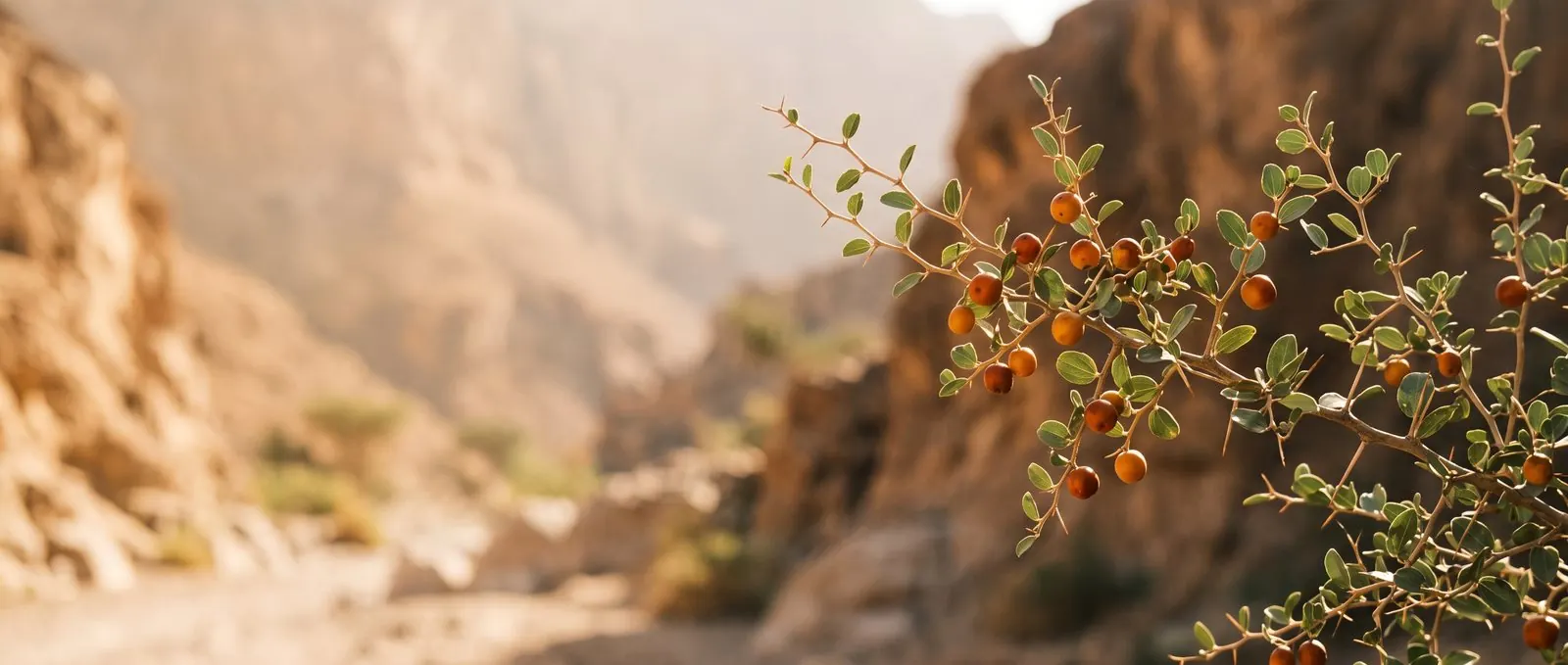
Sidr (Arabic: سدر) is a tree — Ziziphus spina-christi, a thorny, drought-hardy evergreen of the Arabian Peninsula, the Levant and the Horn of Africa. The same word is used for the tree's dried, ground leaves, used for washing for centuries, and it gives its name to Sidr honey, which bees make from the tree's blossom.
In English it is called Christ's thorn jujube, and in translations of the Quran the lote tree. Its everyday names in other languages are further down this page.
Sidr in English
There is no single English word. Botanists use Christ's thorn jujube; translators of the Quran usually write lote tree; and around the Gulf the fruit is often called nabq or nabk, its Arabic name. 'Jujube' on its own is only a family resemblance: the Chinese jujube sold as a fruit is a different species, Ziziphus jujuba.
Sidr in the Quran and the Sunnah
The tree is named four times in the Quran: among the few lote trees left to the people of Saba' (34:16), as the Sidrat al-Muntaha, the lote tree of the utmost boundary (53:14 and 53:16), and among the thornless lote trees of Paradise (56:28).
In the Sunnah it appears in washing. Sahih al-Bukhari records the Prophet ﷺ instructing that the deceased be washed with water and Sidr — in the narration of Umm 'Atiyyah about his daughter, and of the man who died in ihram. That is why Sidr leaves are used for the ghusl of the deceased in many Muslim communities today, and why many households keep some at home.
Some families also add crushed Sidr leaves to water as part of ruqyah. Scholars differ on the details of the practice, and it is worth asking someone whose knowledge you trust.
What the tree gives
- Honey — from the blossom, during a bloom of a few weeks a year. The most valuable thing the tree produces.
- Leaves — dried and ground into the powder used to wash hair and skin.
- Fruit — nabq, a small date-like drupe eaten fresh or dried across the region.
- Shade and timber — in rural Yemen a mature Sidr is often treated as a shared asset rather than a crop.
Sidr in other languages
Search for 'sidr leaves' in Hindi, Malay or Tamil and you will meet a different word — and often a different tree. Find yours below; the last column says honestly whether the local word names this exact species.
Sidr honey
Sidr honey is honey made mainly from the blossom of the Sidr tree. Because the tree grows across a wide range, so does the honey — from Saudi Arabia to Pakistan — but the name alone says little about what is in the jar. The useful questions are where the trees stood and in which season the bees worked them.
Sidr honey from three named Yemeni valleys →
Common questions
What does Sidr mean?
Sidr (سدر) is the Arabic name of the tree Ziziphus spina-christi, known in English as Christ's thorn jujube or, in translations of the Quran, the lote tree. The word is also used for the tree's ground leaves.
What is Sidr called in Hindi and Urdu?
Usually ber or beri (बेर / बेरी, بیری), and the leaves beri ke patte. Strictly, those words most often name the Indian jujube, Ziziphus mauritiana, a close relative of the Arabian Sidr.
What is Sidr called in Malay and Indonesian?
Bidara, and the leaves daun bidara. In Malaysia and Indonesia the name usually refers to the Indian jujube, Ziziphus mauritiana, a close relative of Ziziphus spina-christi.
Is Sidr the same as jujube?
They are relatives in the same genus. Sidr is Ziziphus spina-christi; the jujube sold as a fruit is usually Ziziphus jujuba. They are different species.
What is Sidrat al-Muntaha?
The lote tree of the utmost boundary, mentioned in Surah an-Najm (53:14). The word sidrah is the singular of the same Sidr.