
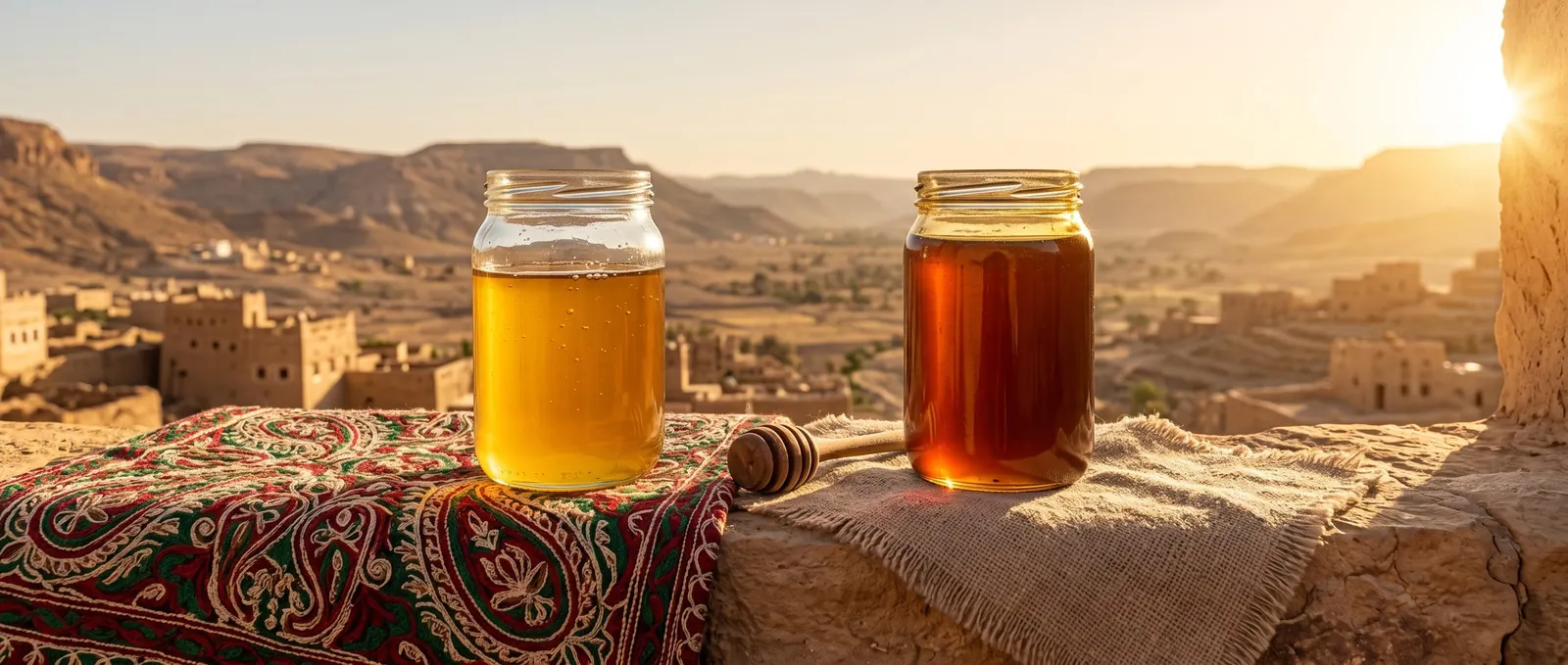
This comparison is usually written by whoever sells one of the two. We sell Yemeni Sidr, so read us with that in mind — and we will argue it the way we argue Sidr against Manuka: both are real honeys, and the honest question is not which is fake but what, exactly, you are paying for in each jar.
Different trees, mostly
Yemeni Sidr is a single-species honey: Ziziphus spina-christi, the Sidr tree of the Arabian Peninsula, foraged during one bloom. Kashmiri Sidr, by its own sellers' descriptions, is gathered from several Ziziphus species at once — jujuba, mauritiana, nummularia, oxyphylla, with spina-christi among them — flowering across the valley in late spring.
Ziziphus is the jujube family, so both are jujube-family honeys and both can fairly be called Sidr. But a one-species, one-valley, one-bloom honey and a several-species regional blend are different products, the same way a single-estate olive oil and a supermarket blend are — whichever of the two you prefer.
Different climates make different honey
Kashmir is a temperate Himalayan valley with reliable water; its Ziziphus bloom comes in late spring. Yemen's Sidr country is arid: the trees on the slopes of Hadramout and Shabwah are largely unirrigated and bloom after the autumn rains. A tree under water stress yields less nectar and concentrates what it produces — which is why Yemeni Sidr is characteristically dense, low in moisture and long in the finish, and why there is much less of it.
The price difference is real — here is what it buys
Kashmiri Sidr typically retails around $30–40 per kilogram. Yemeni Sidr is quoted anywhere from $150 to over $500; our own jars work out to about $280 per kilogram, and our bulk gallons to about $142. Sellers of the cheaper honey sometimes call that gap a geopolitical surcharge, and freight and insurance out of Yemen genuinely do cost more than freight out of India.
But most of the gap is older than the war and simpler: yield arithmetic. Wild unirrigated trees produce a fraction of what watered orchards produce, the bloom is short, and the hives must be trucked to it. Scarcity of that kind was setting Sidr's price centuries before container insurance existed.
When the Kashmiri jar is the right buy
If you want a pleasant jujube-family honey for everyday use at a tenth of the price, with a more consistent year-round supply, Kashmiri Sidr is a reasonable purchase and we will not pretend otherwise.
When the Yemeni jar is
If what you are buying is the specific thing — the dense, caramel-forward character of a Wadi Do'an autumn harvest, a label that names its valley and season, honey from a supply chain short enough to describe — that exists only one place, and the price reflects what it costs to bring it out of that place.
The three Yemeni harvests, each with its valley and season named →
Common questions
Is Kashmiri Sidr honey real Sidr honey?
It is a genuine honey from Ziziphus (jujube-family) trees, typically gathered from several species blooming together in Kashmir's late spring. Yemeni Sidr is a single-species Ziziphus spina-christi honey from one bloom — both are real; they are different products.
Why is Yemeni Sidr so much more expensive than Kashmiri Sidr?
Mostly yield arithmetic: wild, unirrigated trees, one short autumn bloom, nomadic beekeeping and small per-hive yields — plus genuinely higher export costs from Yemen. Kashmiri harvests are temperate, better-watered and more abundant, which honestly shows up in the price.
Do Kashmiri and Yemeni Sidr honey taste different?
Side by side, yes. Yemeni Sidr is typically denser, darker and longer in the finish, with caramel and malt character; multi-species Kashmiri honey is lighter and more floral. Within Yemen the valleys differ too — Hadrami, Shabwani and Usimi are distinct harvests.