
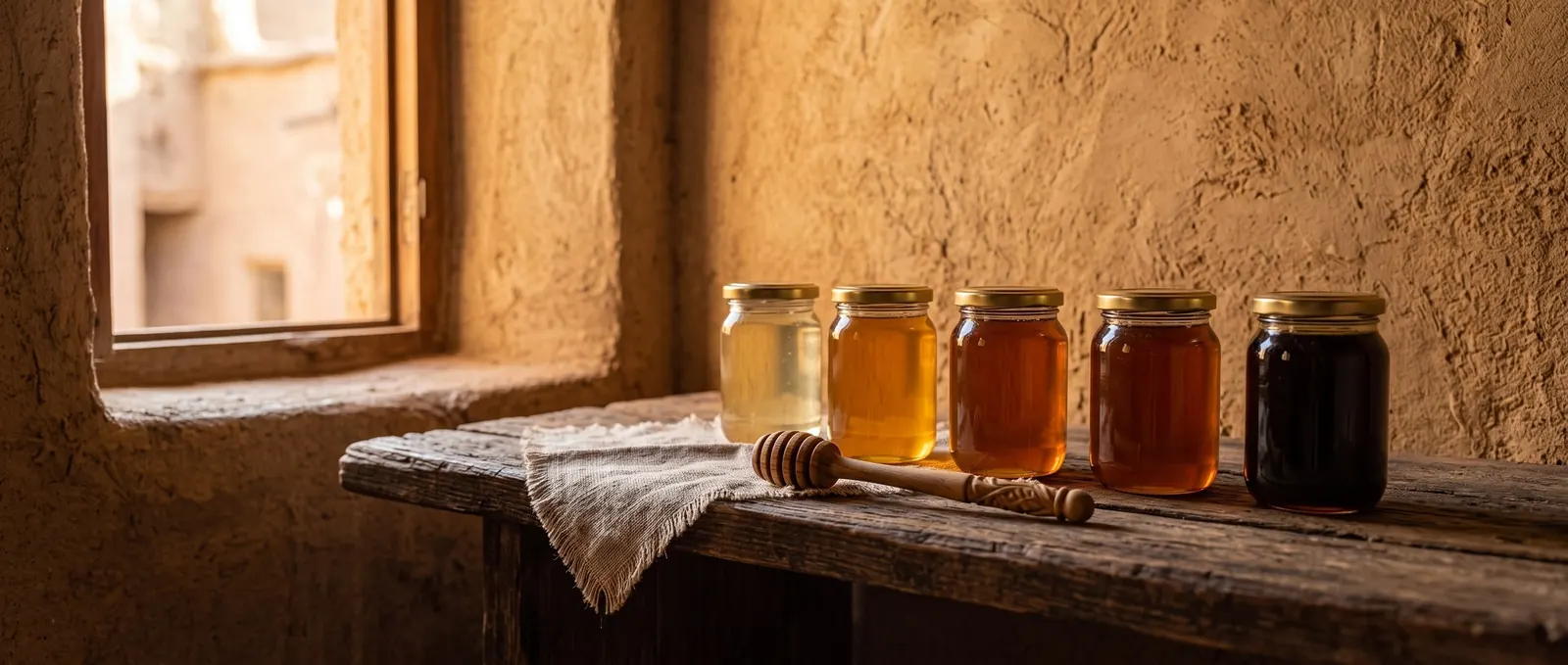
People go looking for a Manuka alternative for three honest reasons: high-UMF jars have become seriously expensive, the taste — earthy, slightly medicinal — is not for everyone, and curiosity about what else the category holds. We sell one of the alternatives below, so read us knowing that; the rest of the list is played straight.
What people are actually looking for
Strip away the branding and Manuka's appeal is specific: a dense, dark honey from one named plant in one named place, produced seriously and studied in laboratories rather than just marketed. That is the standard an alternative has to meet — a single-origin honey with a real identity, not a supermarket blend with better packaging.
Sidr honey — the closest analogue
Sidr honey from Yemen is what we make, and it is the alternative most often named alongside Manuka. The parallels are real: one tree (Ziziphus spina-christi), one short bloom, named valleys, small yields, and a laboratory record — a 2011 study compared nine honeys including both against nine bacterial species under identical conditions, and named Yemeni Sidr among the strongest tested. That happened in a dish, not in a person, and we keep the full study with its limits in our research library.
Where it differs from Manuka is the eating: Sidr is rounder and denser — caramel and malt with a long finish, none of Manuka's sharpness — which is why it is the easier of the two to eat by the spoonful.
The rest of the shortlist
- Tualang (Malaysia): from wild rainforest trees bees colonise rather than hives, harvested by climbers; dark, slightly sour, and one of the more studied Asian honeys.
- Jarrah (Western Australia): from a eucalyptus that flowers every other year; dark amber, low in glucose, slow to crystallise, with a malty character.
- Ulmo (Chile): from a temperate rainforest tree; pale and floral with vanilla notes — the gentlest honey on this list.
- Buckwheat (widely produced): the accessible option — dark, strong, molasses-edged, and a fraction of the price of everything above.
How to judge any of them
Manuka's UMF and MGO grades are unique — no other honey has an equivalent, Sidr included. So for every alternative the check is the same: origin specificity. A named region, a named season, a seller who can describe their own supply chain. That question does the work a grade would do, and a seller's fluency in answering it tells you most of what you need.
And apply the price test: genuinely scarce single-origin honeys cost what their yields dictate. A 'wild rare honey' at blend prices is answering the question for you.
Our three Sidr harvests, each with its valley and season named →
Common questions
Is Sidr honey a good alternative to Manuka?
It is the most commonly named one: single-tree, single-origin, genuinely scarce, with published laboratory comparisons that included both honeys. It tastes rounder — caramel and malt rather than Manuka's medicinal edge. Neither is a medicine.
Is there another honey with a UMF-style grading system?
No. UMF and MGO exist only for Manuka. For every other honey, including Sidr, the practical check is origin specificity — a named region and harvest season from a seller who knows their supply chain.
What tastes closest to Manuka honey?
Nothing matches it exactly. Buckwheat shares its intensity at a much lower price; Jarrah shares the dark, malty register; Sidr is denser and sweeter-finishing. Taste is the one axis where 'alternative' does not mean 'imitation'.