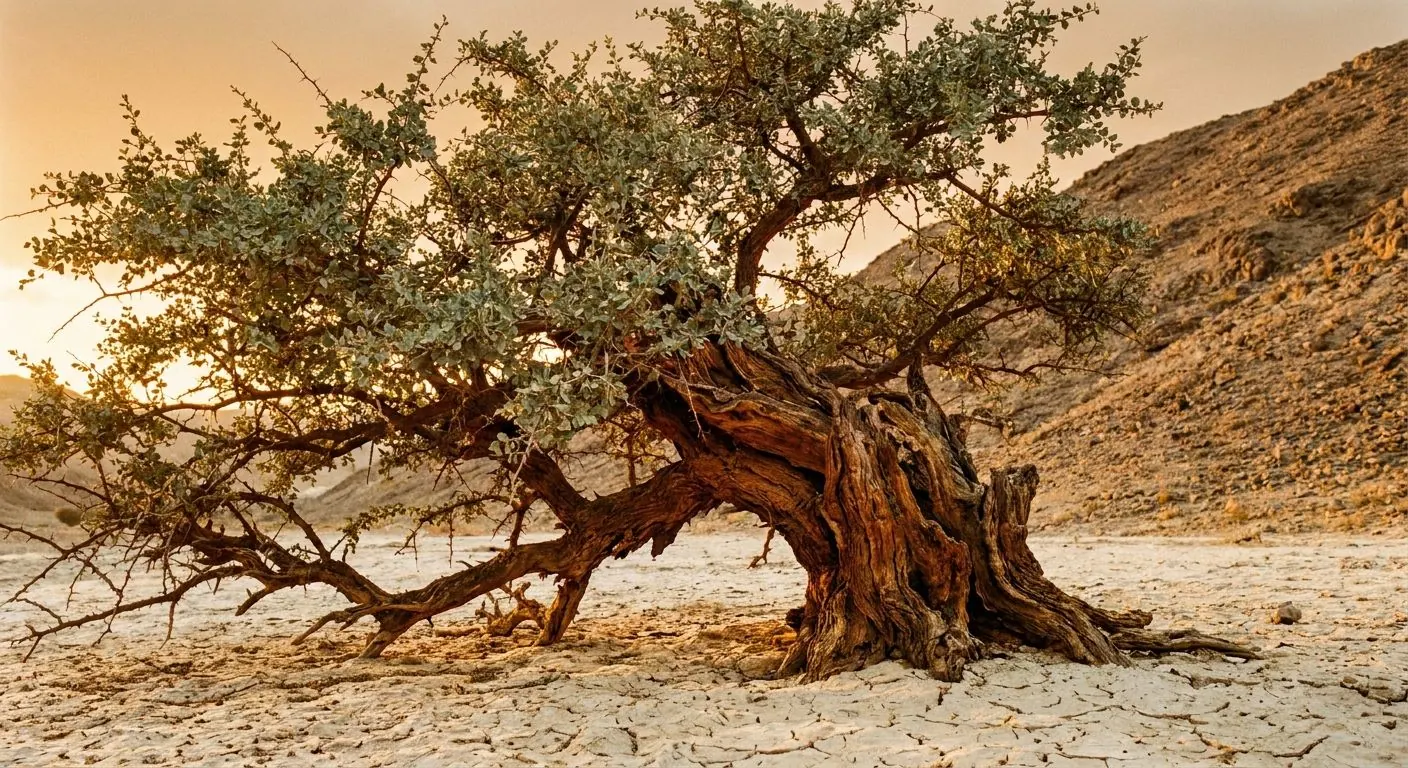
The Sidr tree is Ziziphus spina-christi, a thorny evergreen that grows across the Arabian Peninsula, the Levant and the Horn of Africa. It is the tree whose blossom produces Sidr honey, and it is also, in Yemen, a fruit tree, a shade tree, a source of leaf powder used for washing, and one of the few large plants that will grow on ground where almost nothing else does.
Understanding the tree explains almost everything about the honey — including why it costs what it does.
Taste what this tree makes: three Yemeni Sidr harvests, each from a named valley →
It survives where farming does not
Sidr has a deep taproot and small, waxy leaves that lose very little water. It tolerates drought, heat, poor soil and a degree of salinity. In much of Yemen it grows uncultivated on valley floors and slopes that no one would attempt to farm.
This matters commercially in a way that sounds like marketing but is not. A plant under water stress produces less nectar, and the nectar it does produce is more concentrated — less water, more sugar and aromatic compounds per drop. Irrigate the same species and yields rise while density falls.
It flowers for a few weeks a year
The main Sidr bloom in Yemen falls in the cooler months, and it is short — a matter of weeks, not months, and it does not arrive in the same place at the same time each year. Rainfall decides both.
That single fact sets the entire economics. There is no way to extend the season, no way to plant your way to a bigger harvest, and no second cut. Beekeepers move hives to wherever the bloom has arrived, sometimes hundreds of kilometres, and take what those weeks give them.
The tree is not only about honey
- The fruit, a small date-like drupe, is eaten fresh and dried across the region.
- The leaves are dried and ground into a powder long used for washing hair and skin.
- The wood is dense and slow-growing, historically used for tools and building.
- The canopy provides shade and the roots hold soil on slopes that would otherwise erode.
In much of rural Yemen a mature Sidr is treated as an asset held in common rather than a crop — which is part of why the old trees are still standing.
Why any of this should matter to a buyer
Because it is the only honest explanation of the price. Sidr honey is expensive for reasons that are structural — a short bloom, wild trees, small yields, hand harvesting and no way to scale any of it — rather than because of a grading number or a marketing claim.
If a seller cannot tell you where their trees grow and when the harvest was, they are selling you the name of the tree rather than what the tree produced.
Common questions
What is the scientific name of the Sidr tree?
Ziziphus spina-christi. It belongs to the buckthorn family, Rhamnaceae, and is sometimes called Christ's thorn jujube in English.
Where does the Sidr tree grow?
Across the Arabian Peninsula, the Levant and the Horn of Africa. In Yemen it grows uncultivated in the valleys of Hadramout, the highlands around Usimate and the plateau of Shabwah.
How often does the Sidr tree flower?
Once a year, mainly in the cooler months, for a period of weeks. The timing shifts with rainfall, which is why beekeepers move hives to the bloom rather than keeping them in one place.
Is Sidr the same as jujube?
They are close relatives. Ziziphus spina-christi is the Sidr of the Arabian Peninsula; Ziziphus jujuba is the Chinese jujube. Honey labelled 'jujube' is usually from a different species than Yemeni Sidr.