
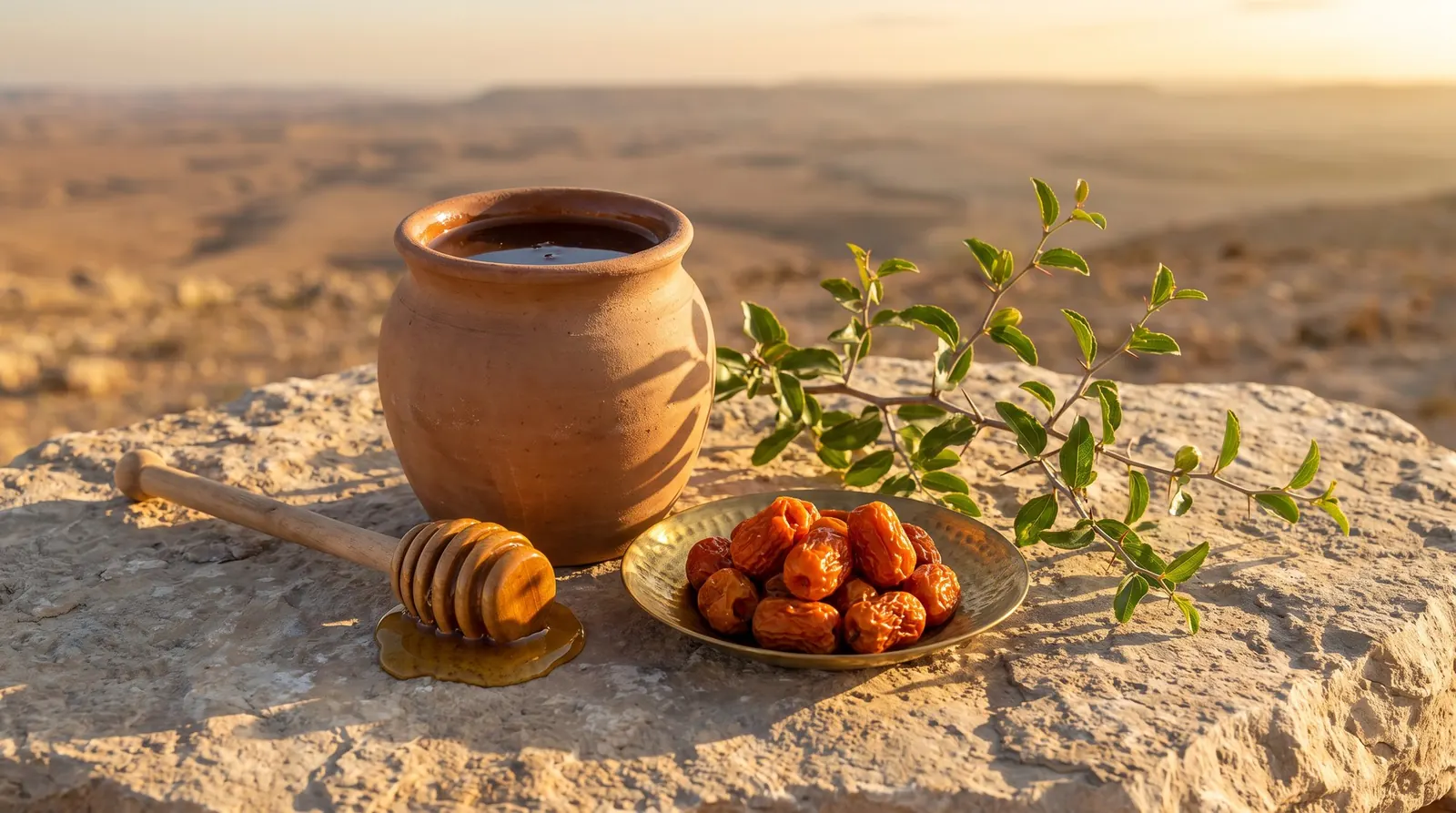
Shabwani Sidr honey is a single-origin raw honey harvested in the Shabwah governorate of southern Yemen, directly west of Hadramout. While Hadrami Sidr from Wadi Do'an is the honey most buyers meet first, Shabwah is Yemen's second-largest honey-producing region, according to a 2023 report by the Sana'a Center for Strategic Studies. Grown on higher, drier and more open plateau ground, the Sidr trees of Shabwah give a darker, denser honey with a deep, resinous profile and a faintly bitter finish that sets it apart from the sweeter caramel notes of its eastern neighbour.
The landscape of Shabwah: plateau, desert and old caravan roads
To understand why Shabwani Sidr honey tastes different from other Yemeni harvests, it helps to look at the map. Hadramout is famous for narrow, steep-sided canyons like Wadi Do'an, which cut deep into the limestone plateau. Shabwah, sitting just to the west, is much more open, consisting of a dry plateau at low to mid altitude that bridges the interior desert, the mountains and the coast.
As a 2021 report in The Guardian notes, Shabwah's varied terrain gives bees seasonal pastures across coastal plains, deserts and mountains. The governorate's capital, Ataq, acts as the central market hub where regional wholesalers and keepers gather to trade the season's yield, according to the same Guardian report. Within Yemen's domestic trade, specific valleys carry their own reputations: the 2023 Sana'a Center report notes that Yemeni Sidr is often named by its exact district, with honey from Shabwah's Jardan district known simply as Jardani.
This dry plateau has been a trading crossroads for over two millennia. According to an essay from The Metropolitan Museum of Art's Heilbrunn Timeline of Art History, the ancient Incense Route began at Shabwah in the old kingdom of Hadhramaut and ran by camel caravan for sixty-five stages to the Mediterranean. Long before anyone packed honey into jars for export, Shabwah was already sending the harvest of its dry-land trees out into the wider world.
The Sidr tree on dry ground
The tree behind Shabwani Sidr honey is Ziziphus spina-christi, commonly called Christ's thorn jujube and known across Yemen as Sidr or, in southern dialects, elb. According to a 2021 ethnobotanical study by M. Al-Fatimi covering 250 informants across five southern governorates including Shabwah and Hadramout, local people call the tree elb, its small sweet fruit daoom, and the edible seed kernel inside fersoos. The fruit is eaten fresh or dried and sold in local markets, making the tree a staple of rural life long before the honey harvest begins.
In a follow-up 2024 survey of 1,020 informants by Al-Fatimi, Ziziphus spina-christi and Vachellia tortilis (the Samr acacia) ranked as the two most important forage plants for bees in southern Yemen, with the Sidr honey known locally as asal ilb. While Sidr is the prized harvest of the year, Shabwah's trees do not bloom all at once, and a single floral source cannot feed a colony for twelve months. According to a 2021 Al Jazeera report on the Shabwah harvest, Samr honey from Acacia tortilis blooms from March to May and ranks second in quality and value across the governorate, while a spring harvest called Dhabyan from February to April ranks third. For the rest of the year, when the main trees are resting, bees gather a lighter multifloral pasture honey called Marāʿī, which as The Guardian notes in its 2021 report provides continuous work and income for keepers between the major blooms.
How beekeeping and the autumn harvest work in Shabwah
Beekeeping in Shabwah is not a backyard hobby; it is a large rural livelihood. According to the local agriculture office cited by Al Jazeera in 2021, Shabwah is home to about 26,000 beekeepers managing roughly 300,000 hives. Nationally, the industry supports around 100,000 small-scale beekeepers, according to a 2023 Food and Agriculture Organization (FAO) report, and a 2020 UN report cited by The Guardian estimates Yemen's total annual honey production at roughly 1,580 tonnes, with about 840 tonnes exported.
Because the bloom moves with the rain and the elevation, Yemeni beekeeping is nomadic. As the 2023 Sana'a Center report details, the national Sidr bloom follows a strict autumn calendar: it begins in early September in the northern highlands of Sa'ada, moves in mid-September to Osaymat in Amran, reaches Hadramout, Shabwah, Marib, Abyan and Hajjah in October, and finishes in early November on the coastal Tihama plains. During the rainy seasons, beekeepers from Shabwah also travel into neighbouring Abyan to find blooming pasture, according to a 2021 United Nations Development Programme (UNDP) report.
Moving hundreds of colonies across dry country requires care. In his 2021 book Beekeeping in Hadhramout, published by Hadhramout University, researcher M. S. Khanbash explains that hives are moved exclusively at night to keep the bees from flying, a practice also documented by The Guardian in 2021 when bees are sleepy and calm. Keepers stack long traditional cylindrical clay pipes, hollowed logs or wooden box hives three or four rows high on iron stands, shading them with grass mats against the desert sun, as observer Julian Lush recorded on al-bab.com in 2001.
One quiet piece of craft separates genuine single-origin Sidr from mixed pasture honey. According to Khanbash's 2021 study, experienced beekeepers harvest and clear all old honey from the hives just before moving their colonies into Sidr country in October. That clean-out ensures the autumn comb holds only Ziziphus spina-christi nectar. As Eric Hansen observed in a 1995 article for Saudi Aramco World on Wadi Do'an's keepers, the purest autumn elb honey from Shabwah's Jardan valley was known simply as Kharfi, meaning 'of the autumn'.
When the forty-day flowering window closes, the harvest is done entirely by hand. Keepers open the rear plug of the long horizontal hives, cut the white combs with a knife one by one, and stop as soon as they reach the brood at the front, according to Khanbash's 2021 work. In Shabwah, Al Jazeera reported in 2021, keepers harvest the combs by hand into metal cans or press them with traditional tools, straining the liquid honey through cloth without heat or fine filtration.
In recent years, keeping this schedule has grown much harder. The 2023 Sana'a Center report notes that landmines and military checkpoints frequently block migration routes, and that the ranks of beekeepers now include internally displaced people and unpaid civil servants looking for a way to earn a living. Night moves by truck have even been tracked from the air by military drones, according to The Guardian's 2021 reporting, while an FAO feature notes that during severe dry spells, the high cost of transporting hives or buying pollen grains to keep bees alive sometimes forces keepers to abandon their colonies.
Shabwani vs Hadrami Sidr: taste, texture and who each suits
In the Gulf markets of Saudi Arabia and the United Arab Emirates, buyers treat regional harvests much like specialty coffee drinkers treat single-estate beans from Haraz or Yirgacheffe, or how date buyers compare succulent Medjool to drier, firmer Ajwa. Historically, prominent beekeepers from both Shabwah and Hadramout supplied Gulf royals directly, sometimes booking orders years in advance, according to the 2023 Sana'a Center report. Neither region is objectively 'better', because they offer noticeably different flavours from the same tree.
In our own tastings across our three harvests, the differences come down to colour, sweetness and finish. Hadrami Sidr from Wadi Do'an is what most people picture when they hear the name: thick, slow-pouring, and built around warm caramel and malt notes with a long, sweet finish. Usimi Sidr, from the cooler, greener mountains of Usimate, is much lighter in body and floral on the tongue. Shabwani Sidr sits at the opposite end of the spectrum from Usimi.
Because Shabwah is a drier, higher plateau, our Shabwani harvest is the darkest of the three. Its texture is just as dense and heavy on the spoon as Hadrami, matching Khanbash's 2021 description of Yemeni Sidr as having very high viscosity. In the mouth, however, Shabwani trades some of Hadrami's upfront caramel sweetness for a deep, resinous, almost woody character, ending with the distinct, fiery and faintly bitter aftertaste that The Guardian's 2021 report notes as a hallmark of traditional Yemeni Sidr.
| Harvest | Region & landscape | Texture | Flavour & finish | Best suited for |
|---|---|---|---|---|
| Shabwani Sidr | Shabwah (arid plateau, low to mid altitude) | Dense, heavy on the spoon | Dark, deep and resinous with a faintly bitter finish | Experienced Sidr eaters who prefer less sweetness and more depth |
| Hadrami Sidr | Wadi Do'an, Hadramout (deep desert canyon, low altitude) | Thick and slow-pouring | Rich caramel and malt, long sweet finish | First-time Sidr buyers and eating straight from the spoon |
| Usimi Sidr | Usimate (green mountain highlands, high altitude) | Lighter and looser (sold with comb in the jar) | Gentle, floral and waxy | Gifting, chewing whole honeycomb, and kitchens wanting a mild honey |
We always tell readers plainly: Shabwani is our most divisive honey. If you are buying your first jar of Yemeni Sidr, or if you love classic sweet, buttery caramel flavours to drizzle over warm bread or labneh, Hadrami Sidr is the better choice and you will likely enjoy it more. If you want something delicate and floral, choose Usimi. Shabwani is the collectors' jar—the one our repeat customers come back for once they know the style and want a darker, less sweet, resinous spoonful to pair with strong, unsweetened Arabic coffee or black tea.
How to check a Shabwani origin claim
Because Yemeni Sidr sells for eight to ten times the value of other local honeys, according to Khanbash's 2021 research, labels claiming Hadrami or Shabwani origin are common, and there is no government seal or single laboratory test that can distinguish a Shabwah canyon from a Hadramout valley after the fact. Checking a regional claim means looking at how the seller sources and describes the honey before you buy.
- Check the harvest season. Pure Shabwani Sidr is harvested once a year after the autumn bloom in October and November, as documented by the Sana'a Center (2023) and Khanbash (2021). A seller offering a 'fresh spring batch' of top-grade Shabwani Sidr is either selling the minor March bloom or a different floral source such as Samr.
- Ask for the district or beekeeping group. Shabwah is a large governorate; genuine importers know whether their honey came via the Ataq market, from Jardan, or from a set number of family apiaries. Our Shabwani harvest, for example, comes from nine beekeeping families who move their hives onto the plateau each autumn.
- Look for honest tasting notes. If a brand sells both Hadrami and Shabwani Sidr and describes them both with identical copy as 'sweet, mild and floral', be cautious. Real Shabwani has a resinous depth and a faint bitter edge on the finish; a seller who actually tastes their batches will warn you about that.
- Understand what 'raw' and 'unfiltered' really mean. In traditional Yemeni practice, liquid honey is strained through cloth to remove wax cappings and bee parts, as Khanbash (2021) records, but never heated or ultra-filtered. A jar that is completely clear and thin like corn syrup has likely been heated or fine-filtered.
- Ask for composition lab sheets, not invented grading numbers. Yemen has no official numerical grading scale for its honey. If you want to read published peer-reviewed studies on the composition of Yemeni honeys—such as the 2002 paper by Al-Mamary and colleagues in Nutrition Research on total phenolics—you can visit our research library page for information only.
よくあるご質問
Why does Shabwani Sidr honey have a slightly bitter finish?
A faint bitter or fiery edge on the finish is a classic trait of traditional Yemeni Sidr, noted in field reporting by The Guardian. In Shabwah, where Ziziphus spina-christi trees grow on a dry plateau at low to mid altitude, the autumn harvest develops a deeper, more resinous flavour than valley harvests.
Should a first-time Sidr buyer choose Shabwani or Hadrami?
Start with Hadrami from Wadi Do'an. Its caramel-and-malt sweetness is immediately approachable and represents the classic flavour profile most people expect from Yemeni Sidr, whereas Shabwani's darker, resinous character is best suited to people who already know Sidr and want less sweetness.
What is Jardani honey, and is it the same as Shabwani Sidr?
Jardani is Sidr honey harvested specifically in the Jardan district of the Shabwah governorate, as noted by the Sana'a Center for Strategic Studies. All Jardani Sidr is Shabwani, though Shabwani Sidr can also come from other Sidr-growing districts across Shabwah.
When is Shabwani Sidr honey harvested?
The prized Shabwani Sidr harvest takes place once a year in autumn, following the October and November flowering of the Sidr trees. While Shabwah beekeepers also harvest Samr (acacia) honey in spring and multifloral Marāʿī honey during the rest of the year, true Sidr is an autumn crop.
Is Shabwani Sidr honey heated or filtered?
Traditional Shabwani Sidr is harvested by hand from the back of the hive and strained through cloth into containers, never heated and never commercially ultra-filtered. Straining removes pieces of wax comb while leaving the honey's natural pollen and dense texture intact.
出典
- Sidr Honey vs Normal Honey: Benefits, Taste & Yemen Origin – Aurum Apis
- An Ancient Tradition at Risk: Yemen’s Beekeeping and Honey Production in Times of War - Sana’a Center
- Liquid gold: beekeepers defying Yemen war to produce the best honey | Yemen | The Guardian
- Yemeni Honey: a transcendent legacy
- The Metropolitan Museum of Art, Heilbrunn Timeline of Art History: Trade between Arabia and the Empires of Rome and Asia, 2000
- Al-Fatimi M, Ethnobotanical study on Ziziphus spina-christi in southern Yemen, 2021
- Al-Fatimi M, Survey of bee forage plants in southern Yemen, 2024
- Al Jazeera, Honey harvest season in Shabwa, Yemen, 2021
- Food and Agriculture Organization (FAO), Yemen beekeeping country profile news, 2023
- Sana'a Center for Strategic Studies, An Ancient Tradition at Risk: Yemen's Beekeeping and Honey Production in Times of War, 2023
- Khanbash M. S., Beekeeping in Hadhramout, Hadhramout University, 2021
- Lush J., Bee-keeping in Yemen, al-bab.com, 2001
- Hansen E., The Beekeepers of Wadi Du'an, Saudi Aramco World, 1995
- Al-Mamary M, Al-Meeri A, Al-Habori M, Nutrition Research, 2002
ご検討中ですか?
お好きな時に使える、初回注文$10オフ
「収穫便り」では、新蜜の入荷情報やイエメンの物語、最初の一瓶に使える限定コードをお届けします。